

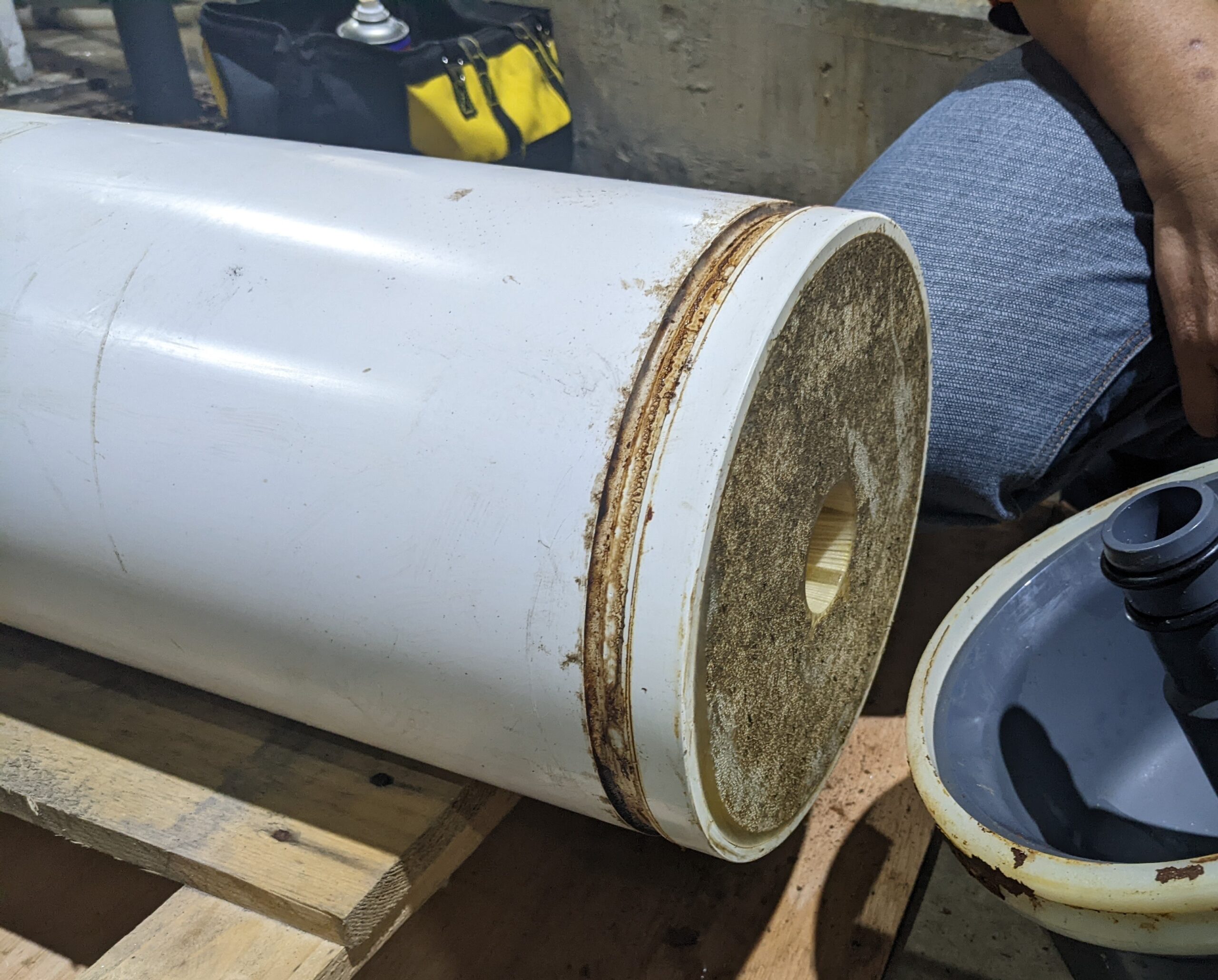
Fouling is one of the most common causes of performance loss in reverse osmosis (RO) and ultrafiltration (UF) systems. The term refers to membrane fouling: an accumulation of substances on or within the membrane. Fouling directly affects the system’s efficiency and almost always leads to lower capacities, higher pressures, higher pressure differentials, lower recovery rates, and higher energy consumption.
What is fouling?
Although fouling is a general term, there are several types, each of which develops in a different way:
1. Biofouling
What is bioflouling?
Biofouling in membrane technologies such as RO and UF is the accumulation of microorganisms—such as bacteria, algae, and fungi—that attach to the membrane and continue to grow there. This creates a sticky biofilm that reduces water flux and increases pressure, thereby raising energy consumption.
How does biofouling form?
The formation of biofouling depends on various factors. First, microorganisms must be present in the water. Additionally, the right conditions must be present for the microorganisms to grow, such as sufficient organic and inorganic nutrients, high temperature, and oxygen. The latter depends on whether the bacteria require oxygen to grow (aerobic bacteria) or do not require oxygen (anaerobic bacteria). Factors such as flow rate and the type of membrane surface also influence biofilm formation.
Where does biofouling commonly occur?
Biofouling of membrane systems is common when treating pond water, surface water, or wastewater. The risk increases when the water is warm and stagnant. For example, algae blooms often occur in the summer in open storage ponds or in surface water. Contaminated wastewater contains many microorganisms that can also cause biofouling.
How can you prevent biofouling?
Biofouling can be prevented in various ways. This is often achieved through prefiltration and disinfection of the water before it passes through a RO membrane. Prefiltration can consist of sand filtration or ultrafiltration (UF), which physically remove microorganisms. UV disinfection or chemical disinfection kills microorganisms, preventing them from forming a biofilm on the RO membrane. A proper combination of mechanical filtration and disinfection significantly reduces the risk of biofouling.
2. Organic fouling
What is it?
Organic fouling in RO and UF systems occurs when natural, synthetic, or microorganism-derived organic substances adhere to the membrane surface. These can include humic acids, sugars, fats, oils, pesticides, or other organic molecules. This results in the formation of an organic layer that reduces water flux, increases pressure, and raises the system’s energy consumption.
How does it occur?
Organic fouling occurs because both the membrane surface and the organic substances have a specific electrical charge, causing them to attract each other. This process is also known as adsorption. The risk of organic fouling depends on the type of organic substance, the membrane type, and the water chemistry—such as the pH value—which influences the charge of both the membrane and the organic substances.
Where does it commonly occur?
Organic fouling occurs primarily in the treatment of surface water and drainage water. Drainage water often contains many different organic substances, such as root exudates, humic acids, organic fertilizers, and pesticides. When organic substrates, such as coconut fiber, are used, the risk of fouling is higher. Organic contamination can also occur in surface water, for example, due to industrial discharges. Organic fouling and biofouling often reinforce each other: organic layers provide nutrients for microorganisms, which then form biofilms. Algae, for example, also secrete organic substances that adhere to the membrane.
How can you prevent it?
Organic fouling can be prevented through effective pretreatment of the water. Commonly used methods include coagulation, activated carbon filters, ultrafiltration, or nanofiltration for the (partial) removal of organic substances. Pre-treatment can also involve oxidation using ozone, hydrogen peroxide, or free chlorine, which break down organic substances before they adhere to the membrane. Caution is advised here, as these oxidants can also damage the membrane.
3. Colloidal fouling
What is colloidal fouling?
Colloidal fouling and fouling by solids involve the formation of a compact layer on the membrane surface due to the accumulation of suspended solids such as clay, sand, colloidal silica, and iron particles. The solids clog the membrane, reducing water flux, increasing pressure, and raising the system’s energy consumption. In RO membranes, prolonged exposure to colloidal fouling can also reduce the removal of dissolved salts, causing the EC in the permeate to rise.
How does it occur?
Colloidal fouling occurs when undissolved and suspended solids enter the membrane system. These substances are often too small and light to settle and are charged. When colloidal and solid particles accumulate, they can become unstable, causing them to agglomerate and adhere to the membrane. This creates a cake layer on the membrane surface and can block the membrane pores. Factors that play a role here include the charge of the colloidal particle, the pH of the water, and the presence of multivalent ions such as calcium and magnesium.
Where does it commonly occur?
Colloidal fouling is common in the treatment of drainage water and surface water, but can also occur in groundwater and rainwater stored in open basins. For example, drainage water contains fine particles that leach out of the substrate or poorly dissolved fertilizers. Drainage water from organic substrates such as coconut coir often contains more suspended solids. Surface water and well water may contain clay and/or sand particles. During heavy wind or rain, clay or sand particles can end up in an open basin.
How do you prevent colloidal fouling?
Prefiltration is essential to prevent colloidal fouling. Commonly used prefiltration techniques to remove colloidal and solid particles include sand or multimedia filtration, paper belt filters, automatic screen filters, disc filters, and cartridge filters. In addition, coagulation can be used to cause colloidal particles to clump together. Ultrafiltration can also be used to remove colloidal particles.
Scaling
In addition to fouling, there is also scaling. These terms are sometimes confused with one another. Scaling results from mineral crystallization, while fouling is the result of biological, organic, or colloidal contamination. Because the approach differs depending on the type of problem, it is important to clearly understand the distinction, in the article What is scalin and how does it occur?, we explain this in more detail. We explain that difference of fouling and scaling in more detail in the article What is the difference between fouling and scaling?
How Do You Recognize Fouling?
Biofouling, organic fouling, and colloidal fouling each have similar yet distinct effects on the performance of a membrane system. This also depends on the type of membrane technology being used.
In ultrafiltration (UF), all three types of fouling cause an increase in membrane resistance. This leads to higher pressure and lower water production. The pressure difference across the membrane also increases.
In reverse osmosis (RO), organic and colloidal fouling lead to a decrease in water production. Colloidal fouling also causes an increase in the pressure difference across the membrane and, in cases of severe fouling, can increase the EC of the permeate. With biofouling, the pressure difference across the membrane primarily increases, but permeate production may also decrease. I
Recognizing fouling: monitoring is essential
Regular monitoring of system performance helps to quickly detect incipient fouling. A platform such as HydroPatrol provides real-time insight into pressure, flow, water quality, and trends, enabling early detection of fouling and allowing maintenance to be performed at exactly the right time.