

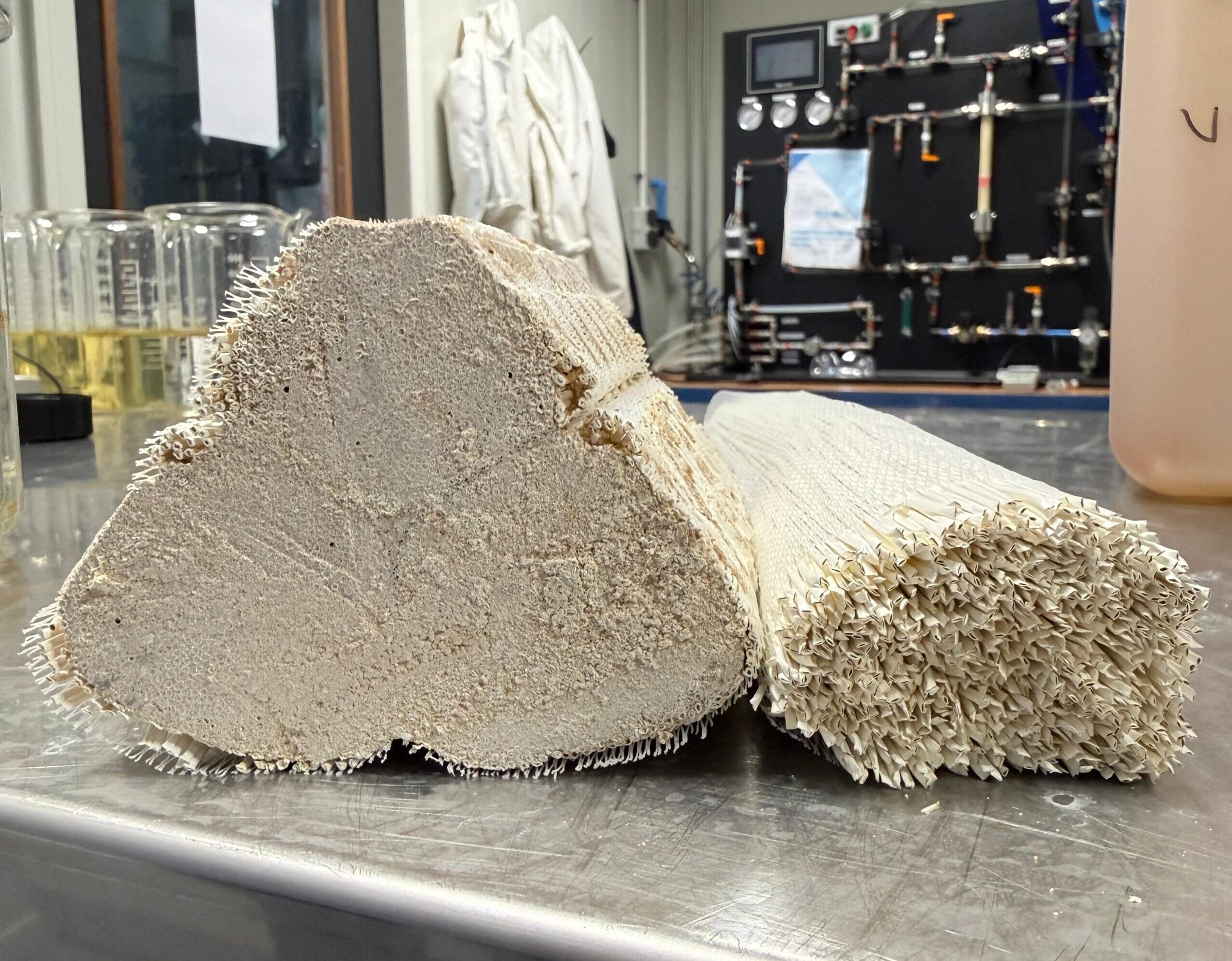
Scaling is one of the most common causes of performance loss in reverse osmosis (RO) systems. Scaling is rare in ultrafiltration (UF) systems. The term “scaling” refers to a specific type of membrane fouling in which poorly soluble inorganic salts precipitate and crystallize on the membrane surface. Scaling directly affects the system’s efficiency and typically leads to lower capacity, higher operating pressure, greater pressure differentials, lower recovery rates, and higher energy consumption.
What is scaling?
Scaling is a form of membrane fouling caused by the precipitation and crystallization of dissolved inorganic salts found in groundwater, surface water, and tap water. This results in a crystalline salt deposit on the membrane surface and in the membrane’s feed channels.
Common forms of scaling include calcium carbonate (lime scale), calcium sulfate, calcium phosphate, silica, and, in some cases, iron and manganese deposits.
Scaling causes the water flux to decrease, while the required pressure and the pressure difference across the membrane increase. This results in higher energy consumption. In addition, scaling can reduce permeate quality, which is often evident as an increase in the salt concentration or the electrical conductivity (EC) of the permeate.
How does scaling occur in an RO system?
Scaling occurs in an RO system when the maximum solubility of a salt is exceeded. Every salt has a limited solubility in water. When the concentration exceeds this limit, the salt can precipitate and deposit as a scaling layer on the membrane surface.
In a reverse osmosis (RO) system, permeate water is produced with a very low salt concentration. This is achieved by forcing brackish or saltwater under high pressure through a membrane that largely allows water to pass through while retaining salts. At the same time, a second water stream—the concentrate—is formed, in which the salts are concentrated. The higher the water production (higher recovery), the higher the salt concentration in the concentrate. When this concentration becomes too high, salts in the concentrate can precipitate and cause scaling on the membrane surface and in the feed channels.
Several factors influence the formation of scaling. First and foremost, the type of salt and the concentration of the salts are important, due to their maximum solubility. This solubility is influenced by the pH and temperature of the water. Many salts are less soluble at higher pH values, and some salts are sensitive to temperature changes.
However, there are exceptions, and different salts behave differently in response to changes in pH and temperature.
In addition, it always takes time for salt crystals to form a process also known as crystal growth or nucleation time. This time can vary from very short to relatively long, depending on the conditions. When multiple salts are present in solution at the same time, they can influence one another, which can either accelerate or slow down the formation of scaling.
Where does scaling commonly occur?
Scaling in reverse osmosis (RO) systems can occur with virtually any type of water. Whenever salts are present in the water, there is always a risk of scaling. This risk is particularly high with water that contains high levels of calcium, magnesium, bicarbonate, sulfate, silica, and phosphate, but varies greatly depending on water quality.
These substances can form poorly soluble salts, such as calcium carbonate, calcium sulfate, calcium phosphate, and silica deposits. During the RO process, these salts are concentrated in the concentrate, which can cause the solubility limit to be exceeded and lead to scaling.
How do you prevent scaling?
There are several methods to prevent scaling in an RO system. An important measure is to limit water production (recovery) so that the concentrate is not concentrated to such a high degree and the maximum solubility limit of salts is not exceeded. In addition, the pH of the water can be adjusted, usually by lowering it, to increase the solubility of certain salts and reduce the risk of precipitation.
Another commonly used method is dosing antiscalants. Antiscalants are special polymers that inhibit the formation and growth of salt crystals by disrupting the attractive forces between dissolved salts. This slows or prevents crystal formation and prevents salts from precipitating on the membrane, or at least slows the process.
In addition, there are pretreatment techniques that counteract specific forms of scaling. For example, a deferrization system can be used to remove iron and prevent iron scaling. Water softeners can also be used to remove calcium and magnesium from the water, thereby preventing limescale buildup on the membranes.
Fouling
In addition to scaling, there is also fouling. These terms are sometimes confused with one another. Scaling results from mineral crystallization, while fouling is the result of biological, organic, or colloidal contamination. Because the approach differs depending on the type of problem, it is important to clearly understand the distinction. In the article What is fouling and how does it occur?, we explain this in more detail.
How Do You Recognize Scaling?
Scaling in reverse osmosis (RO) systems is primarily recognizable by a gradual decrease in permeate capacity, an increase in feed pressure, and a rise in the pressure difference across the membrane. This also increases the system’s energy consumption. In addition, the quality of the permeate may decline, which is often evident as an increase in dissolved salts and rising electrical conductivity (EC) of the permeate.
Regular and structured monitoring of system performance is essential in this regard. A platform such as HydroPatrol provides real-time insight into pressure, flow, water quality, and performance trends, enabling early detection of scaling and allowing maintenance to be performed at exactly the right time.