

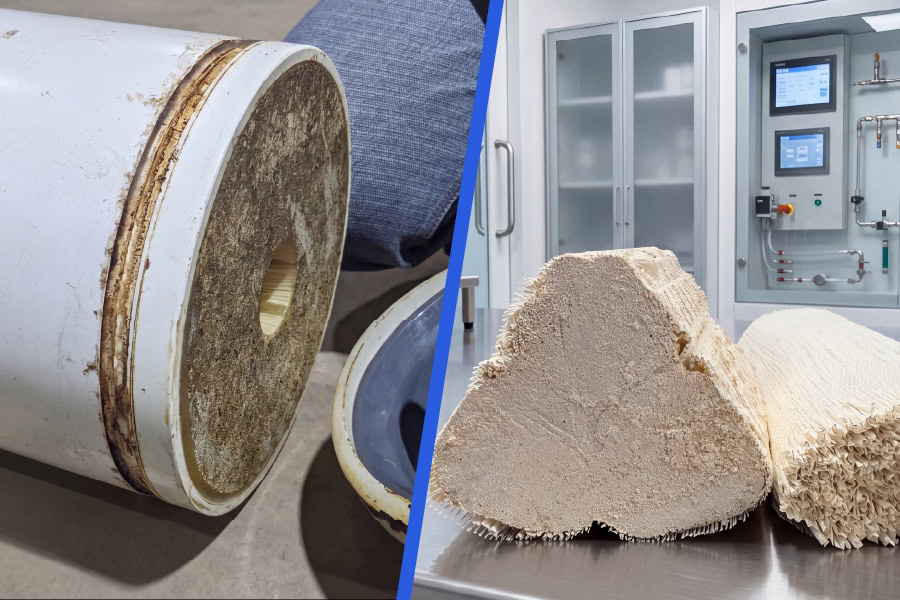
In membrane technology, the terms “fouling” and “scaling” are often used interchangeably, even though they describe different types of membrane fouling. Correctly identifying the type of fouling is essential for determining the cause and preventing damage to the membrane.
What is fouling and scaling
Fouling results from the accumulation of biological, organic, or colloidal particles on the membrane, such as bacteria, biofilm, humic substances, or fine suspended particles. This fouling forms a soft, sticky layer that can clog the membrane and reduce water flux. We explore this topic in more detail in the article What is fouling and how does it occur?
Scaling is a hard, mineral deposit that forms when dissolved substances, such as calcium, sulfates, or silica, precipitate at excessively high concentrations in the concentrate. This process occurs more rapidly at higher recovery settings, as this increases the salt concentration in the concentrate. More information on this topic can be found in the article What is scaling and how does it occur?
How can you tell the difference in performance?
In practice, both fouling and scaling lead to a loss of membrane performance in UF and RO systems. Fouling plays a role in both ultrafiltration and reverse osmosis, while scaling is usually less of a problem in ultrafiltration. The way performance declines depends on the type of fouling or scaling.
Ultrafiltration
In UF, biofouling, organic fouling, and colloidal fouling all lead to a decrease in permeate flow, an increase in feed pressure, and a rise in the pressure difference (ΔP) across the membrane. This also increases the system’s energy consumption. Because UF allows dissolved salts to pass through, scaling rarely occurs unless exceptional conditions are present, such as very high water hardness or abnormal pH levels.
Reverse osmosis
In a reverse osmosis (RO) system, colloidal fouling and scaling cause the permeate flow to decrease. The pressure difference also increases, and permeate quality may decline, as evidenced by higher salt concentration and EC. In the case of biofouling, the pressure difference increases in particular, but a reduction in permeate flow may also occur. With biofouling, the pressure difference increases primarily, but the permeate flow may also decrease. With organic fouling, the permeate flow decreases primarily, while pressure loss and permeate quality often remain unchanged. In some cases, the pressure difference may also increase with organic fouling.
How can you physically tell the difference by looking at the membrane?
Although changes in system performance can sometimes be similar across different types of fouling, a visual inspection of the membranes can often help distinguish them physically:
Biofouling and organic fouling
In RO: soft, slimy (and sometimes malodorous) deposits on the front RO membrane. In UF: soft, sticky deposits across the entire UF membrane, sometimes with an odor.
Scaling
In RO: hard, granular, or crystalline layer on the last RO membrane, where the salt concentration in the concentrate is highest. In UF: occurs rarely.
Colloïdale fouling
In RO: a thin, compact layer of fine particles; may be slightly grainy or have a matte sheen, often less pronounced than scaling. In UF: deposits can clog the membrane; sometimes light brown or gray in color; feels firm but not sticky.
Membrane autopsy
To determine exactly what is causing a membrane to become fouled, a membrane autopsy can be performed. This involves opening a membrane module and visually inspecting the membrane. In addition, microscopic images are often taken for example, using a light or electron microscope to determine the composition and nature of the contamination, such as biofouling, organic layers, colloidal deposits, or scaling.
Removal of fouling and scaling
When fouling or scaling is present, it can be removed through chemical cleaning, a process known as Cleaning-In-Place (CIP). For this purpose, a CIP unit can be installed, allowing for the preparation of an optimal cleaning solution and the creation of the appropriate cleaning conditions.
Biofouling and organic fouling can often be effectively removed through cleaning at a high pH. In a UF system, this can be combined with free chlorine. Scaling, on the other hand, is effectively removed at a low pH. For colloidal fouling, the required cleaning agent may vary. There are also specially developed agents that can be used for CIP to target specific contaminants.