

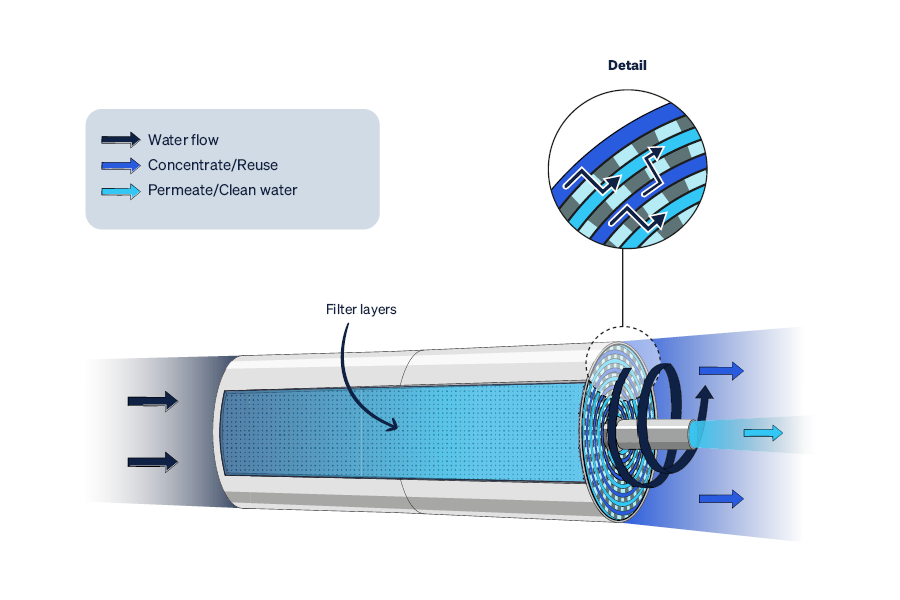
In reverse osmosis (RO), electrical conductivity (EC) is an important indicator of the purity of the produced water. A low EC indicates a very low concentration of dissolved salts. In horticulture, EC is used to monitor the nutrient content in irrigation and drainage water, while in water treatment, EC primarily provides insight into the purity of the water and the efficiency of the process. A low EC is essential in applications where accurate and stable water quality is required, such as in greenhouse horticulture and industrial process water.
What exactly is EC?
EC stands for electrical conductivity and is a measure of the amount of dissolved salts (ions) in water. These salts make the water electrically conductive: the more dissolved salts, the higher the EC value. EC is expressed in millisiemens per centimeter (mS/cm) and is widely used to assess water quality and composition. In reverse osmosis, these salts are largely removed, giving osmosis water a very low EC, typically between 0.0 and 0.2 mS/cm.
What factors determine the EC of RO water?
1. Quality of the source water
The EC of the source water significantly determines the EC of the RO water. The higher the EC of the incoming water, the greater the amount of dissolved salts that must be removed by the RO membrane. RO membranes have a high salt rejection rate, typically between 99.2 and 99.8%, depending on the membrane type and operating conditions. As a result, highly saline or contaminated source water with a high EC can still lead to an elevated EC in the permeate.
2. Membrane condition
The condition of the RO membrane has a direct impact on the EC of the osmosis water. Key factors include:
Scaling:
Salt deposits on the membrane surface locally increase the salt concentration, allowing more ions to pass through the permeate and raising the EC.
Fouling by colloids:
Accumulation of colloidal particles can restrict flow and increase the local salt concentration, causing the EC of the permeate to rise.
Chemical damage
Oxidizing agents such as chlorine or ozone can reduce membrane integrity, allowing more salts to pass through the membrane and causing the EC to rise.
Mechanical factors
Leaking O-rings or permeate tubes can cause mixing of concentrated water with permeate, resulting in a higher EC.
Aging or wear
Prolonged use or normal wear can reduce membrane integrity, allowing more salts to reach the permeate and increasing the EC.
3. Pressure and temperature
The EC of osmosis water is influenced by the applied pressure and the temperature of the water:
Pressure
Osmotic pressure is the natural pressure created when water wants to flow through a semi-permeable membrane from a low to a high salt concentration. To force water through the RO membrane and effectively remove salts, the applied pressure must be higher than this osmotic pressure. If the pressure is insufficient, the water flow through the membrane decreases, the local salt concentration at the membrane surface increases, and salt rejection may decrease, causing the EC to rise.
Temperature
Electrical conductivity increases at higher temperatures because ions are more mobile than at lower temperatures. Therefore, EC is often reported at 25°C. At varying temperatures, the measured EC may temporarily differ, while the actual amount of dissolved salts remains unchanged. At higher temperatures, water becomes less dense, increasing the flow rate through the membrane, but at the same time, selectivity (rejection) decreases slightly. This can lead to a higher EC in the permeate.
4. Recovery setting
The recovery setting of an RO system determines how much permeate water is produced from the source water. At a higher recovery rate, less wastewater is produced and the production of osmosis water increases. At the same time, the salt concentration in the concentrate increases, widening the difference in salt concentration between the concentrate and the permeate. This concentration difference acts as a driving force that causes some dissolved salts to pass through the membrane despite the fact that the membrane blocks most salts. As a result, the EC in the osmosis water may increase.
When should you take action?
A rising EC in RO water can be an indication of one or more of the following problems:
It is advisable to actively monitor EC trends in the RO water so that incipient fouling or process deviations are detected early and maintenance can be performed in a timely manner.
How does monitoring help with this?
A platform such as HydroPatrol provides real-time insight into the water quality, pressure, flow, and membrane condition of reverse osmosis systems. Through automatic alerts and trend analysis, deviations can be detected early, preventing downtime or membrane failure and allowing maintenance to be scheduled in a timely manner.
Want to know more?
Every application requires a tailored solution. Is your question not addressed in this article, or would you like to discuss your specific situation? Please contact one of our specialists. We are happy to assist you with expert advice and practical support.