

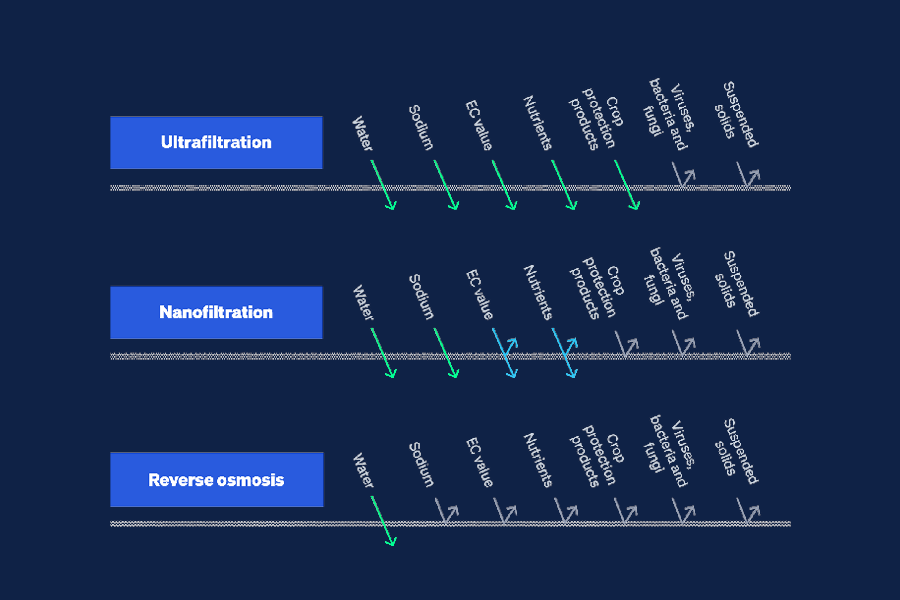
In water treatment, ultrafiltration (UF), nanofiltration (NF), and reverse osmosis (RO) are often mentioned in the same breath. These techniques operate on the same principles, whereby water is forced through a membrane under pressure and contaminants are retained by the membrane. However, UF, NF, and RO each remove different contaminants. Understanding these differences helps in selecting the right technique for the right application, whether it involves purifying drainage water, stabilizing irrigation water, or desalinating process water.
Ultrafiltration (UF): removes microorganisms and suspended solids
Ultrafiltration uses membranes with pores between 0.01 and 0.1 microns. With this, UF removes:
UF does not remove dissolved salts or nutrients. This makes the technology particularly suitable for the safe reuse of drainage water, as valuable nutrients are retained.
The UF technology, as applied in solutions such as the Kathari, also offers highly predictable water quality because pathogens are physically blocked.
UF is an excellent choice when microbiological safety or clarity is the primary goal, without altering the chemical composition of the water.
For a more detailed explanation of how this technique works, its applications, and key considerations, please refer to the article What is ultrafiltration?, which explains UF step by step.
Nanofiltration (NF): intermediate step with partial softening
Nanofiltration forms the link between UF and RO. The pores are smaller than in UF, ranging from approximately 0.001 to 0.01 microns, but still allow some monovalent salts such as potassium, nitrate, and sodium to pass through. NF primarily removes:
NF is often used when decolorization, softening, or targeted reduction of specific salts is desired, but complete desalination, as with RO, is not necessary.
This makes NF an energy-efficient intermediate solution, with lower pressure, higher water yield, and a concentrate with a less extreme composition than with RO.
Reverse osmosis (RO): removes virtually all dissolved substances
RO has the finest separation level: the membrane allows virtually only water molecules to pass through and thereby removes virtually all dissolved substances, including:
RO is ideal when a low EC or complete desalination is required. The technology is essential for tap, brackish, or surface water, or when water quality needs to be significantly stabilized.
Water recovery plays an important role. Thanks to intelligent concentrate management, systems such as the HPRO extract more water from the same source water than conventional RO systems.
For more in-depth information on how reverse osmosis works, pressure buildup, and the difference between permeate and concentrate, see the article What is reverse osmosis?
Contamination and membrane maintenance
All membrane technologies (UF, NF, and RO) can, to a greater or lesser extent, be affected by contamination in practice:
Regular maintenance, flushing, pre-filtration, and water quality management are essential to ensure reliable membrane operation. Our experts are there for you to help.
When should you choose which technology?
In many installations, these techniques are combined. Pre-filtration and proper membrane protection are critical to the reliability and lifespan of the entire system.
Want to know more?
Every application requires a suitable solution. Is your question not addressed in this article, or would you like to discuss your specific situation? Please contact one of our specialists. We are happy to assist you with expert advice and practical support.