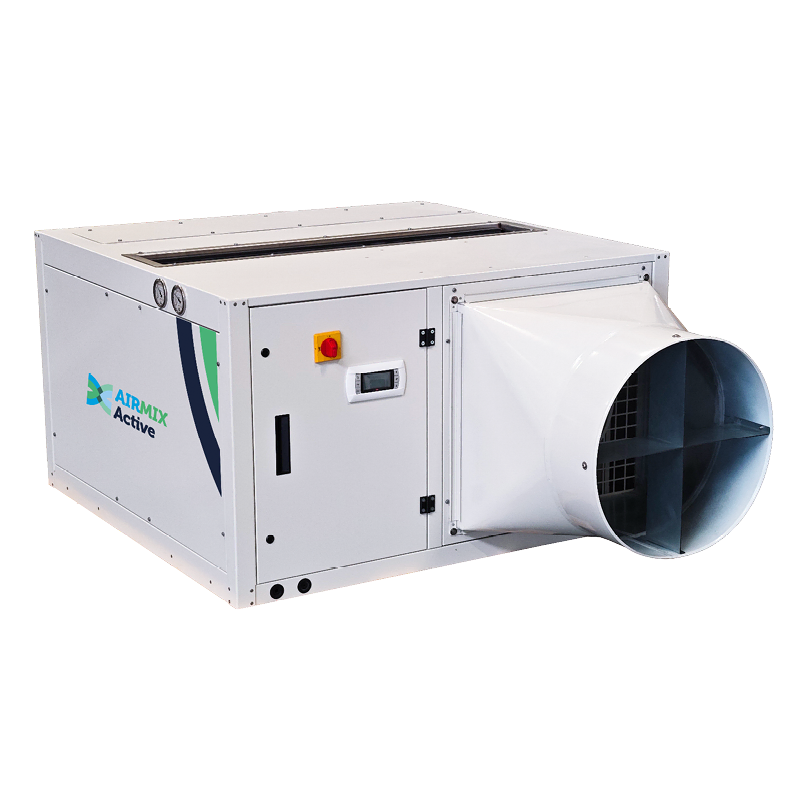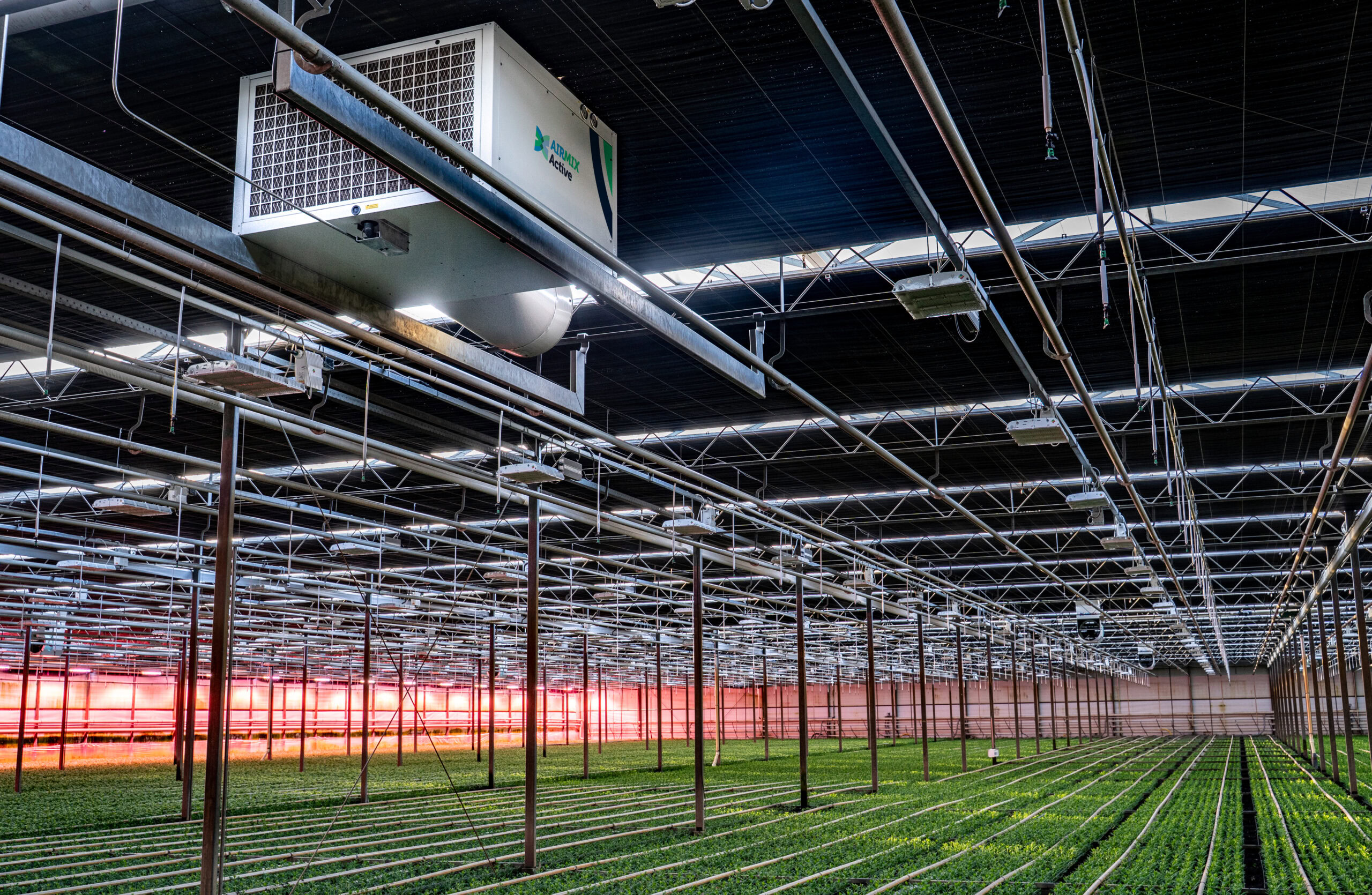
Ten years ago, Van der Ende Group introduced a successful product with Airmix: a smart concept for dehumidifying and cooling greenhouses with dry air from above the screen. However, when relative humidity was high and the temperature difference between inside and outside was minimal, the Airmix remained out of action. That is why Van der Ende Group is now introducing a concept to bridge that period of the year: the Airmix Active. Active dehumidification with a heat pump now makes it possible to control the climate in all conditions.
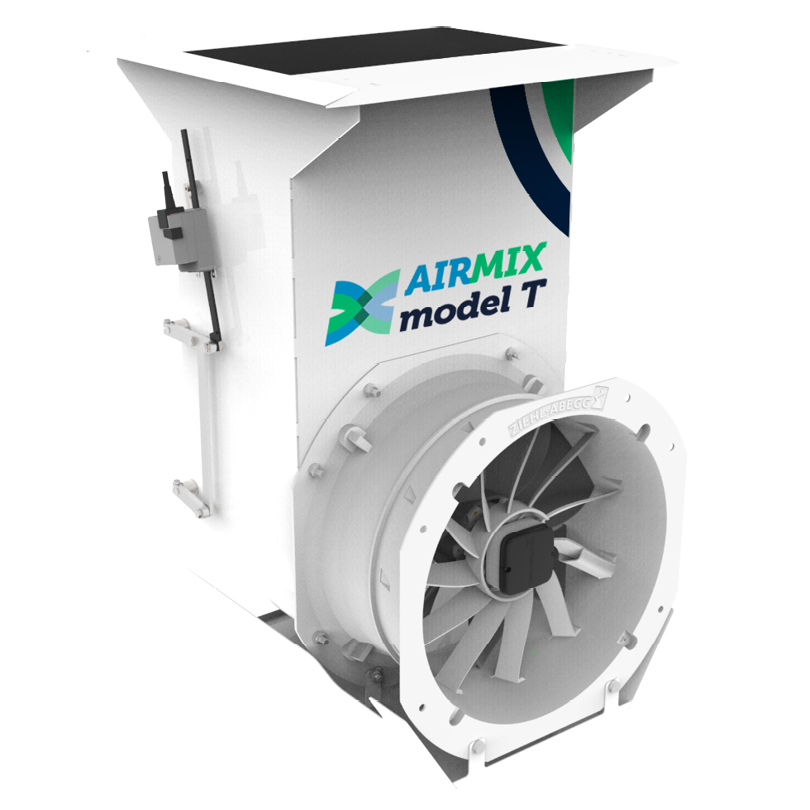
For about two-thirds of the year, dehumidification with the ‘standard’ Airmix with its passive dehumidification proves to be an energy-efficient solution. In summer, there is often less demand for heat in the greenhouse. The dry and cooler air above the screen is then sufficient to maintain the climate in the greenhouse at the right level. In these situations, the Airmix Active blows air from above the screen into the cultivation area without actively dehumidifying. The concept is then comparable to an Airmix model T or G. Active dehumidification is simply not necessary. In roughly one-third of the year, passive dehumidification is not desirable. For example, because the air above the screen is too warm and/or too humid. In other cases, the air above the screen is too cold, making it undesirable to bring it inside. At such times, the heat input of the Airmix Active is particularly effective, because you can dehumidify and heat at the same time.
Integrated heat pump
In such cases, the Airmix Active is automatically controlled via the climate computer to actively dehumidify using the integrated heat pump. The control is therefore located in the climate computer, which determines when active dehumidification is required based on set values. This ensures that the greenhouse climate remains stable even under less than ideal conditions. The result is an optimal climate throughout the year, achieved in the most energy-efficient way possible. In addition, the complete Airmix system ensures well-designed air distribution throughout the greenhouse, both horizontally and vertically. The result is a consistent and uniform climate throughout the entire growing area.
Heat recovery
When the Airmix Active is activated, all valves that draw air from above the screen close automatically. The Airmix system then switches entirely to internal circulation. No cold or humid air is drawn in from above the screen, ensuring that the heat inside the greenhouse is retained.
The integrated heat pump extracts moisture from the greenhouse air and returns heat via the heat exchanger. This extra heat helps maintain the greenhouse temperature, reducing the need for supplemental heating.
With an electrical power consumption of approximately 5.3 watts per m², about 17 watts of heat per m² is returned to the greenhouse. This is comparable to an excess temperature of approximately 18 degrees with 4 × 63 mm overhead heating in a 9.60-meter trellis, resulting in significant savings on gas consumption.
In situations with a combined system of Airmix model T/G and Airmix Active, in combination with a double screen, the calculation model developed by DLVge shows that savings of up to 25% on total energy input are possible
More efficient cultivation with a hybrid system
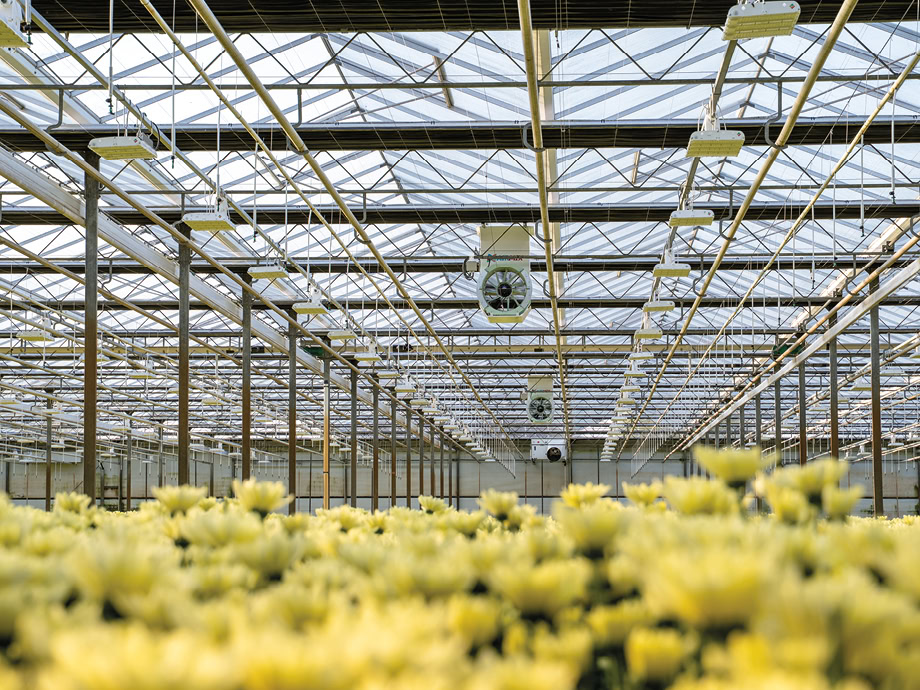
The combination of passive and active dehumidification makes the Airmix system a hybrid solution. If the relative humidity above the screen is low enough, the standard Airmix with passive dehumidification is sufficient. If the difference between the greenhouse and above the screen is too small or, conversely, too large, for example in the case of air that is too cold, too humid, or too warm, the Airmix Active automatically switches on. With current energy prices and tax pressures, switching smartly between these two forms of dehumidification is becoming increasingly important. This collaboration between the two systems allows growers to cultivate more efficiently on balance, resulting in lower energy consumption and an optimal greenhouse climate.
‘Two different systems in terms of control’
Cultivation advisor Theo Roelofs saw the potential of the Airmix Active for chrysanthemum grower Wilco van Vliet. “A good dehumidification system was needed to save energy and improve cultivation,” says Roelofs.
A standard Airmix works on the basis of passive dehumidification with air from above the screen. However, this is less efficient in winter because the air is cold. It then takes energy to heat this air, and the cold air can also have adverse effects on the crop. Roelofs continues: “That’s why I strongly believe in combining a standard Airmix with an active dehumidification system.” He is referring to a hybrid approach: passive dehumidification where possible, active where necessary. “This allows you to choose the best dehumidification method for each season,” says Roelofs.
That’s why I strongly believe in combining a standard Airmix with an active dehumidification system.
Theo Roelofs
Cultivation advisor
With the Airmix Active, the air circulation remains entirely within the greenhouse, and the heat can be used to maintain the temperature in the greenhouse. This saves on pipe heating. “They are two different systems in terms of control. It is important that they are not active at the same time. With passive dehumidification, both the Airmix model T and the Airmix Active draw air from above the screen for dehumidification. But as soon as the Airmix Active starts active dehumidification, the air intake from above must stop. In that case, the Airmix model T automatically switches to circulation, so that the dry air is distributed evenly throughout the greenhouse. Correct settings and coordination in the climate computer are essential here,” says Roelofs.
The project at Van Vliet was the first in which Airmix Active was used on this scale. This provided with many insights into how to get the most out of the system. The optimal control settings are determined for each crop. In this project, too, the final settings are being refined to achieve the most energy-efficient system possible, combined with an optimal greenhouse climate.
‘Climatically speaking, things are going well’
“I had no pre- or post-flowering,” says chrysanthemum grower Wilco van Vliet from Made. He used to work with a standard circulation system. Since switching to the complete Airmix system, including Active, he has seen a noticeable effect on growth. “It wasn’t that the front of the greenhouse ripened earlier. The climate feels slightly different here and there than before, and now the crop responds the same everywhere.”
The climate throughout the greenhouse is now much more uniform. This even distribution ensures uniform growth, without delays or advances at the edges. “These varieties are susceptible to rust. Now that I’ve opted for the Airmix Active, the climate is good.”
Because the climate is better regulated year-round, the humidity remains within stable margins. As a result, Van Vliet has had no more problems with rust since the installation. “If it’s 7 pm and you close the screen, there’s nothing you can do. Now you open the valve and you still get some fresh air in.”
With the Airmix system, he can now also ventilate and dehumidify passively when the screen is closed. Not only via the standard Airmix units, but also with the Airmix Active when it is running in passive mode. “You just have to look carefully at how it works. You can circulate, ventilate, or actively dehumidify; it’s all a bit intertwined. When you use it, that’s important.”
The strength of the system lies in its flexibility, but it does require attention to ensure correct control. By switching smartly between the three functions, Van Vliet gets the most out of his installation.
Passive when possible, active when necessary, that makes the Airmix Active a hybrid system that delivers year-round performance.
Wide applicability and unique in energy efficiency
The Airmix Active is suitable for a wide range of crops, from ornamental plants to vegetables, and in particular as an extension to existing Airmix installations. Thanks to its modular design, the system can easily be added to sections where additional climate control is desired. Because the Airmix Active, like the other Airmix units, is installed decentrally, its placement is also flexible and scalable.
For crops with more space between the crop and the greenhouse gutter, such as chrysanthemums, gerberas, or roses, air mixing is particularly effective. However, the Airmix Active is also ideal for taller crops such as tomatoes and cucumbers, provided that the air supply is properly adjusted to the crop.
What makes this system unique is its hybrid operation: it automatically switches between passive and active dehumidification, depending on the climate conditions. This ensures that the most energy-efficient form of climate control is always used. Where other systems have to dehumidify continuously, the Airmix Active makes smart use of natural conditions whenever possible. This not only saves energy, but also prevents unnecessary power consumption.
In addition, further development is underway to enable the integrated heat exchanger to also function as a cooler. This allows active cooling on hot days, with the absorbed heat being stored in a buffer for later use, for example in the evening, for heating. This makes Airmix Active a future-proof solution for growers who want to optimize their climate year-round, with maximum precision and minimum energy costs.