

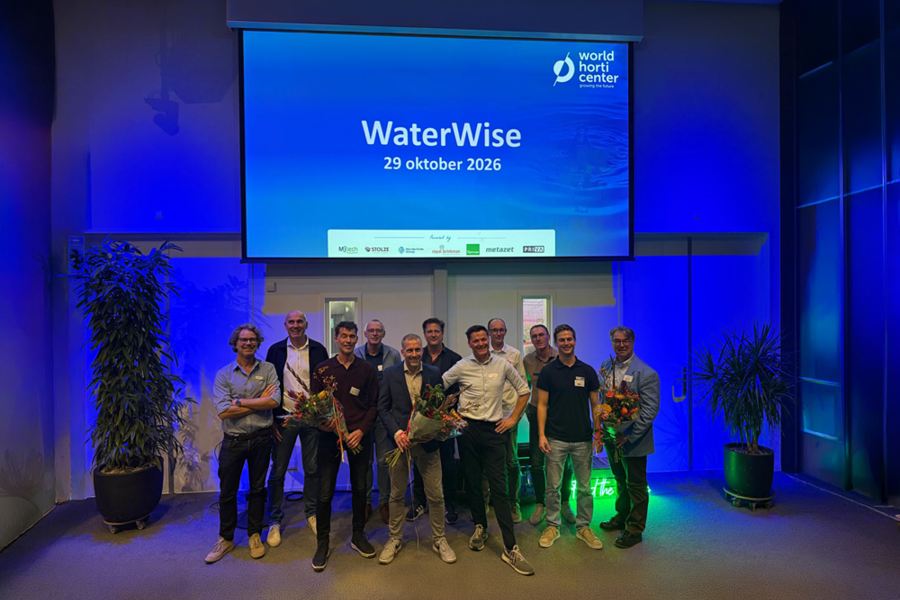
How can you ensure there will be enough water available for your crops in the future, while water quality and emissions standards continue to tighten? And how much water actually disappears unnoticed from your own greenhouse? During WaterWise, held on October 29 at the World Horti Center in Naaldwijk, growers, consultants, and technical specialists came together to find answers. Not only regarding what needs to change by 2027, but especially what’s already possible today.
“Who already feels sufficiently prepared for 2027?” With that question, moderator Matthijs van den Beukel immediately got the attendees thinking. Not many hands went up. Understandably so, because greenhouse horticulture faces a complex challenge. While the Netherlands has traditionally excelled at draining excess water, it is becoming increasingly important to retain that same water. Last summer’s dry spells made it clear that a sufficient supply of irrigation water can no longer be taken for granted. At the same time, pressure is mounting to prevent emissions and improve water quality.
A closed greenhouse isn’t always as closed as you might think
Guus Meis of Glastuinbouw Nederland outlined what lies ahead for the sector as it approaches the important deadline of the Water Framework Directive on December 22, 2027. Stricter regulations require a better understanding of water flows and the prevention of leaks. After all, when fertilizers and crop protection products end up in surface water, it ultimately affects the sector’s future as well.
An interesting development is the research into a potential “zero discharge” certification. This would allow growers to demonstrate that they do not discharge fertilizers or crop protection products into surface water. “There is support for this,” Meis said, although a final decision has yet to be made. Research is also underway to determine whether such a certificate could play a role in the approval policy for crop protection products.
Tomato grower Cock van Schie demonstrated that collaboration truly makes a difference. Together with other farmers in the Oude Broekpolder, he regularly measures water quality in the surrounding ditches. By sharing results, holding each other accountable, and tackling problems together, water quality in the area has improved step by step.
Van Schie is also working with fourteen growers on a project for underground rainwater storage. This promising solution has already required seven years of preparation. According to calculations by KWR, this could reduce the discharge of rainwater into the ditches by 98 percent and cut the use of osmosis water by at least 60 percent. The project demonstrates just how much potential there is, but also why starting early is so important.
From major challenges to tomorrow’s solutions
After looking ahead to 2027, the focus shifted to a more concrete question: what changes can you make yourself tomorrow? Experts from the WaterWise partners demonstrated how filtration, ultrafiltration, reverse osmosis, precision irrigation, and the reuse of drainage water contribute to more efficient water management. They also showed that improvement doesn’t always require a major investment. Sometimes it simply starts with inspecting a pipe, checking a growing trough, or measuring water quality.
Ruben Oosterwijk of Priva summed it up aptly: “The most expensive drop isn’t the one you discharge. It’s the drop you never saw leak away.”
Ruud Grootscholten made it clear just how significant the impact of a leak can be. After all, a leak often entails more than just the loss of water and fertilizers. Consider a more humid greenhouse climate, increased disease and pest pressure, extra energy consumption, and even consequences for employee safety. What starts as a seemingly harmless puddle of water can therefore have far-reaching consequences. That is precisely why timely inspection and proper maintenance are so important.
Sharing knowledge to move forward
What made the afternoon particularly valuable was the combination of practical experience, policy, and technology. Within WaterWise, MJ-Tech (Jurnjan van den Bremer), Stolze (John van der Wilk), Van der Ende Group (Ruud Schulte), Royal Brinkman (Olaf van Kampen), Genap (Chrétien Hendriks), Metazet (Ruud Grootscholten), and Priva (Ruben Oosterwijk) pool their knowledge and expertise.
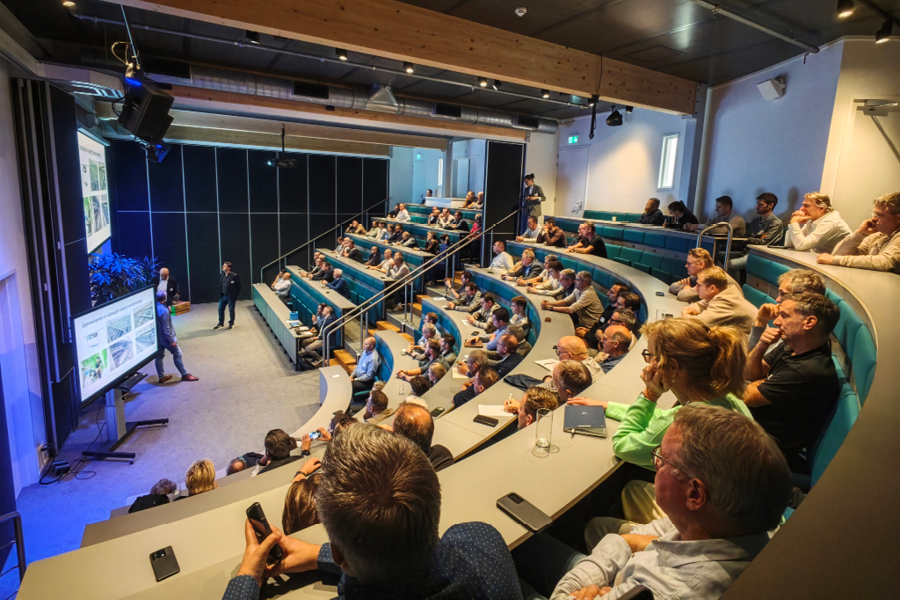
The joint WaterWise pavilion at the World Horti Center introduces visitors to innovative solutions for sustainable water management. The knowledge-sharing session added an extra dimension to this collaboration by also focusing on growers’ questions and experiences.
As moderator Matthijs van den Beukel put it: “Knowledge you share multiplies.”
The afternoon concluded with that thought in mind—not with the illusion that all challenges leading up to 2027 could be solved in a few hours, but with new insights, concrete starting points, and valuable discussions.
Because the future of water management doesn’t begin in 2027. It begins with the choices that growers, advisors, and technical partners make together today.