

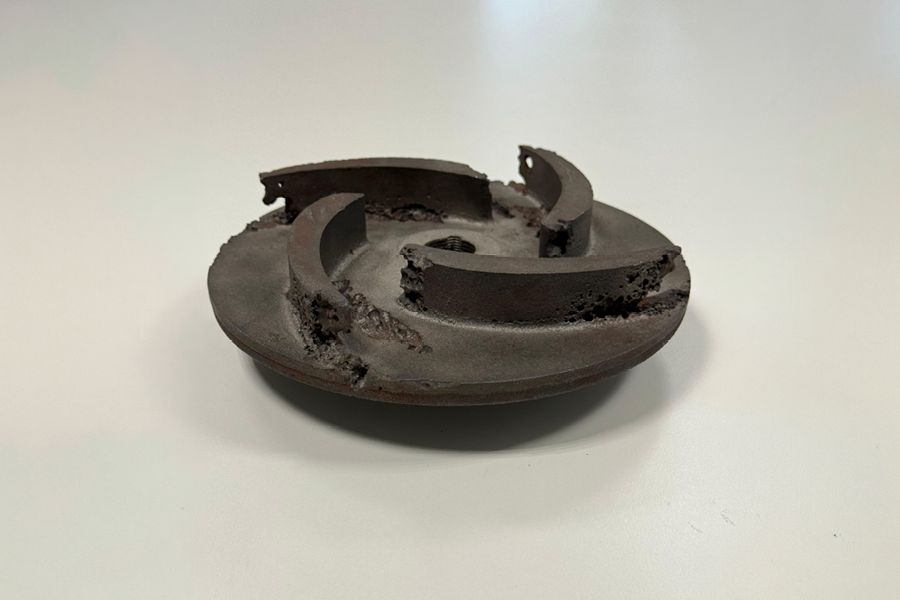
A pump that vibrates or produces a grinding noise is almost never just a minor inconvenience. In many cases, this indicates cavitation: the formation and collapse of vapor bubbles in the impeller. Cavitation not only causes noise and vibration but can also lead to damage to impellers, bearings, and seal faces within a short period of time. In technical installations, we frequently observe this as a result of unfavorable piping configurations or an incorrect NPSH balance.
How cavitation occurs in pump systems
Cavitation occurs when the pressure on the suction side becomes too low. As a result, the fluid begins to boil locally, even though the temperature is well below the boiling point. The vapor bubbles that form implode inside the pump, causing the typical “rattling” or “dragging” sound.
In technical systems, we see that this is primarily caused by:
A pump that originally ran quietly but later begins to vibrate is almost always experiencing one of these situations.
The difference between mechanical imbalance and cavitation
Vibrations in a pump are often attributed to cavitation, whereas in reality they may also be caused by mechanical imbalance. Both produce an abnormal vibration pattern, but their behavior differs clearly:
In overhaul work, we see that cavitation damages the pump much more quickly than mechanical imbalance. The characteristic damage is erosion on impeller edges and face plates, often already visible after a relatively short operating period.
How to prevent cavitation
For technical services and installers, the most important measures are:
Installing pressure gauges on both the suction and discharge sides is strongly recommended. This makes it immediately clear whether the pump is operating within its operating range (pump curve).
If in doubt about system pressures or NPSH conditions, a quick check can prevent significant damage.
How to prevent mechanical imbalance
For technical services and installers, the most important measures are:
In the event of abnormal vibration levels or a sudden increase in noise, a brief mechanical inspection is often sufficient to detect incipient imbalance in a timely manner.
Meer weten?
Elke toepassing vraagt om een passende oplossing. Staat uw vraag niet in dit artikel of wilt u sparren over uw specifieke situatie? Neem dan contact op met één van onze specialisten. Wij helpen u graag verder met deskundig advies en praktijkgerichte ondersteuning.
Want to know more?
Every application requires a suitable solution. Is your question not addressed in this article, or would you like to discuss your specific situation? Please contact one of our specialists. We are happy to assist you with expert advice and practical support.